 NeuralCapital
The Intelligence Behind the Dashboard: Cerence and the Economics of Automotive AI
Want to invest in CRNC?
Visit our How to Invest page to get started with platforms like Fidelity or Robinhood.
The automobile is becoming one of the most consequential testing grounds for artificial intelligence. Once defined primarily by mechanical engineering, the modern vehicle is increasingly shaped by software, connectivity, and the ability to interpret information in real time. The dashboard, traditionally a collection of instruments and controls, is evolving into an intelligent interface between the driver, the vehicle, and the digital world.
This transformation is creating an unusual opportunity for specialist technology companies. Automakers are under pressure to deliver more sophisticated digital experiences, yet developing reliable artificial intelligence internally requires substantial investment and expertise. Cerence Inc. (NASDAQ: CRNC), a Massachusetts-based developer of conversational AI, operates within this increasingly important segment of the automotive industry.
Unlike many emerging AI companies, Cerence is not attempting to establish its first commercial foothold. Its technology is already embedded in vehicles produced by major manufacturers, providing a foundation from which to introduce a new generation of intelligent assistants. The investment question is whether that established position can translate into sustained growth as automotive AI moves beyond conventional voice commands.
From Voice Recognition to Automotive Intelligence
For much of its history, voice technology inside automobiles served a relatively narrow purpose. Drivers could request directions, make telephone calls, or change entertainment settings without taking their hands off the steering wheel. These systems were useful, but their capabilities were constrained by predefined commands and limited contextual understanding.
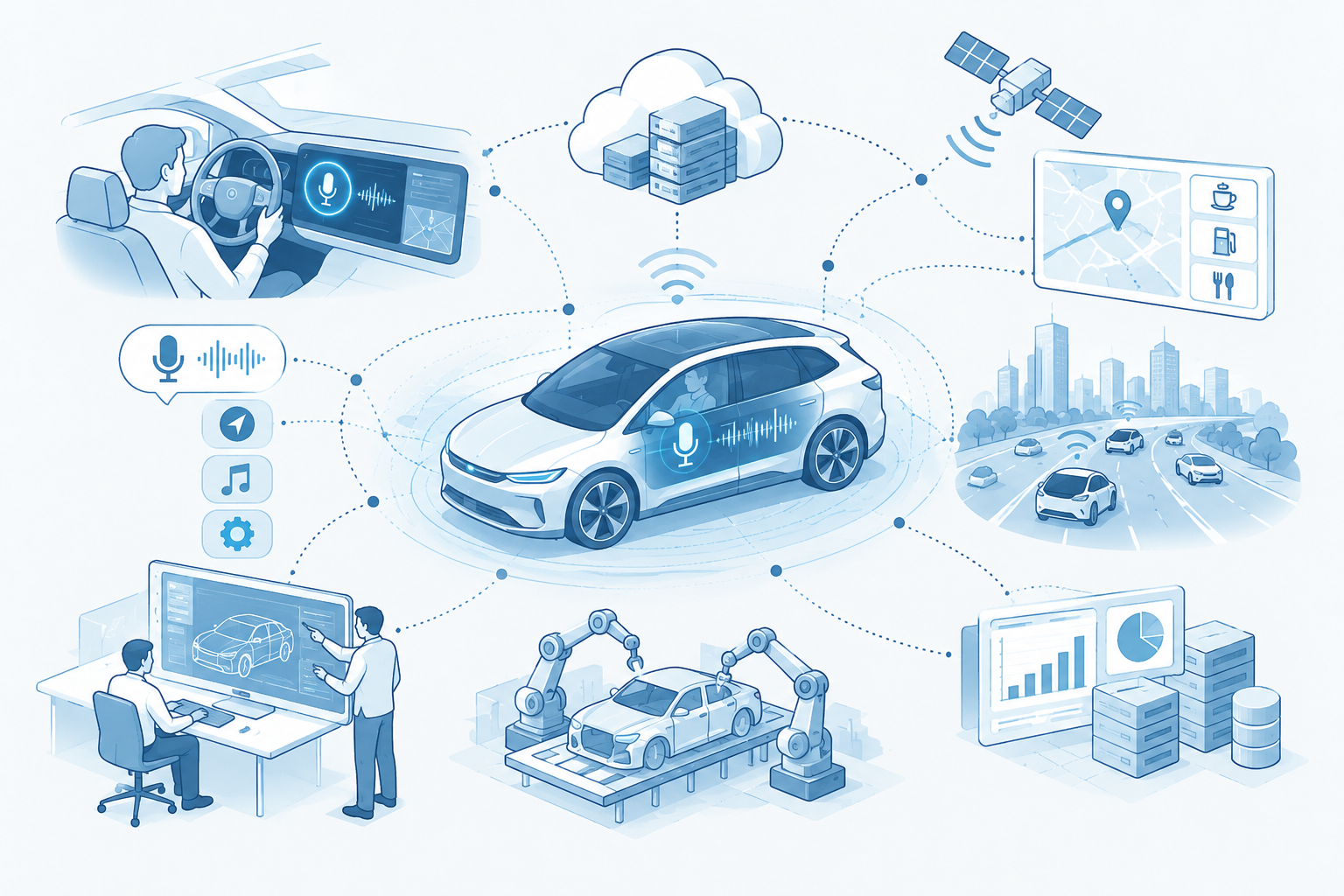
Generative AI is changing those expectations. Instead of memorizing particular phrases, drivers increasingly expect to communicate naturally with their vehicles, asking complex questions, making multiple requests, and receiving responses that reflect their immediate circumstances. A system might identify a suitable charging station, explain an unfamiliar warning indicator, or adjust several vehicle settings through a single conversation.
For automakers, this development represents more than an improvement in convenience. The digital interface is becoming an important point of differentiation, particularly as electric vehicles and advanced driver-assistance systems make the driving experience more software-dependent. A sophisticated AI assistant could eventually become as central to brand identity as performance, design, or interior quality.
Cerence has positioned itself to serve this transition. The company's business combines embedded voice technology, cloud-connected services, and newer generative AI capabilities designed for automotive environments. Its proposition is straightforward: manufacturers can incorporate advanced conversational intelligence into their vehicles without having to build every underlying component themselves.
Cerence: An Established Business in a Changing Market
Cerence became an independent public company in 2019 following its separation from Nuance Communications. Its heritage in automotive speech recognition provided relationships with vehicle manufacturers and experience in developing technology capable of operating under demanding real-world conditions.
That history matters because automotive software is not purchased in the same manner as a consumer application. Manufacturers work through lengthy development cycles, demanding validation procedures, and extensive integration requirements. A technology supplier must demonstrate that its products can operate reliably across different vehicles, languages, hardware configurations, and connectivity conditions.
These requirements create barriers to entry, although they do not guarantee commercial success. Existing supplier relationships can make it easier to compete for future programs, but manufacturers retain considerable bargaining power and frequently evaluate competing technologies.
Cerence reported that its technology was present in approximately 50% of worldwide automobile production over the trailing twelve months ending June 2026. That figure illustrates the scale of its historical automotive footprint, though it should not be confused with market share in the emerging generative AI assistant category.
The distinction is important. Cerence's established position gives it access to automakers and an installed technology base, but the next generation of automotive intelligence remains a competitive market in which past relationships do not automatically secure future contracts.
The Next Generation of In-Car AI
At the center of Cerence's current strategy is Cerence xUI, a platform designed to bring more natural, context-aware, and increasingly autonomous AI interactions into vehicles. Rather than relying exclusively on conventional speech recognition, the platform combines different forms of artificial intelligence to interpret requests and assist with more complex tasks.
The architecture incorporates both cloud-based and vehicle-based capabilities. This hybrid approach is particularly relevant to automotive applications, where response times, connectivity, privacy, and reliability can be more consequential than in ordinary consumer software.
In January 2026, Cerence announced growing automaker adoption of xUI, supported by NVIDIA technology and Microsoft's Azure cloud infrastructure. The company said multiple global automakers were preparing to deploy the platform in production vehicles during 2026.
These relationships are strategically significant, but they require careful interpretation. NVIDIA and Microsoft provide technology infrastructure that supports Cerence's offering; their involvement does not mean that either company guarantees Cerence's commercial success. The more useful measure will be how many production vehicles ultimately incorporate the technology and how much revenue those deployments generate.
Cerence reported another development in August 2026, announcing a multi-brand xUI award from Stellantis. The award suggests that established manufacturers continue to see value in specialist automotive AI suppliers, even as large technology companies expand their own ambitions in the vehicle.
The company is also exploring applications beyond traditional passenger-car assistants. In October, Cerence announced a robotics technology services partnership with Geely, illustrating how conversational interfaces developed for vehicles may find applications in other intelligent machines.
Such diversification offers additional possibilities, but the automotive business remains the principal measure of Cerence's commercial performance. New applications will matter financially only when they progress from technology agreements into meaningful, repeatable revenue.
The Financial Picture: Revenue, Margins, and Cash Generation
Cerence's financial results distinguish it from many smaller companies participating in the AI investment cycle. It has an established revenue base, substantial gross margins, and, more recently, meaningful cash generation. These characteristics provide investors with financial evidence to examine rather than relying entirely on projections of future demand.
For the fiscal third quarter ended June 30, 2026, Cerence reported revenue of $69.6 million, an increase of approximately 12% from the corresponding period a year earlier. Gross margin reached 76%, while the company recorded GAAP net income of $1.5 million, compared with a loss of $2.7 million in the prior-year quarter.
Adjusted EBITDA was $13.5 million, up from approximately $9 million a year earlier. More importantly, the business generated $20 million in operating cash flow and $19.6 million in free cash flow during the quarter.
These figures suggest an improving financial position, but the composition of revenue deserves attention. Cerence operates through three principal revenue categories: software licensing, connected services, and professional services.
Licensing accounted for $41.6 million of third-quarter revenue, making it the largest contributor. Connected services generated approximately $15.5 million, representing growth of just over 20% from the prior-year period, while professional services contributed approximately $12.5 million.
The growth in connected services is particularly relevant to the longer-term investment case. Traditional software licenses are often associated with vehicle production and contractual arrangements, while connected services can provide ongoing revenue as customers use cloud-enabled functionality.
A larger connected-services business could make revenue more predictable and deepen relationships with manufacturers. Nevertheless, its contribution remains considerably smaller than licensing, and investors should avoid assuming that all of Cerence's revenue behaves like a conventional recurring software subscription.
There is another complication. Cerence's revenue can fluctuate because of the timing of fixed licensing agreements, which may produce substantial revenue when contracts are executed rather than being distributed evenly across reporting periods.
During the first nine months of fiscal 2026, the company reported revenue of $248.9 million, compared with $191.1 million in the prior-year period. However, that growth included $49.5 million of one-time revenue associated with an intellectual-property licensing agreement with Samsung.
This distinction materially changes how the headline growth should be interpreted. The Samsung agreement contributed significantly to reported revenue, but it does not represent a recurring annual revenue stream. Investors evaluating Cerence's underlying growth should therefore pay particular attention to connected-services performance, vehicle-related licensing volumes, and the timing of future fixed-license contracts.
For the full fiscal year ending September 2026, management projected revenue between $310 million and $314 million, alongside free cash flow of $76 million to $82 million. These were management forecasts issued in August, not final audited results, and the next earnings release will provide a clearer picture of the company's full-year performance.
A Stronger Balance Sheet, but Not a Debt-Free One
Cerence's improving cash generation has also influenced its capital position. At June 30, 2026, the company reported approximately $127.6 million in cash and cash equivalents, compared with $84 million at the end of September 2025.
The company also reported approximately $173.5 million in long-term debt. Cash therefore did not fully offset outstanding borrowings, making debt management an important consideration despite the improvement in liquidity.
During the first nine months of fiscal 2026, Cerence generated approximately $68.9 million in free cash flow and made $27.6 million in principal repayments on long-term debt. In August, it separately announced the repurchase of $10 million in principal amount of its convertible senior notes due in 2028.
These developments indicate that management is using cash generation to address the balance sheet. They also demonstrate why investors should evaluate debt, liquidity, and future obligations alongside operating profitability.
In August, Cerence's board authorized its first share repurchase program, permitting the company to buy back up to $30 million of common stock over twelve months. The authorization represents a change in capital-allocation priorities, although approval of a repurchase program does not guarantee that the full amount will be spent.
With approximately 45.2 million shares outstanding at June 30, Cerence remains a relatively small publicly traded company despite its global automotive footprint. Shareholders should monitor changes in the share count, stock-based compensation, debt conversion provisions, and the actual pace of repurchases when assessing the value attributable to each share.
The Competitive Question
The opportunity in automotive AI is attracting competitors with very different resources and strategic objectives. Specialist providers such as Cerence and SoundHound AI compete alongside technology companies that supply cloud infrastructure, operating systems, and artificial intelligence models.
Automakers themselves are another important source of competition. Large manufacturers increasingly view software as a strategic asset and may seek greater control over the interfaces through which drivers interact with their vehicles.
For Cerence, this creates a delicate position. Its independence from any single automotive brand may be attractive to manufacturers seeking customizable technology, but those same customers could eventually choose to develop more capabilities internally or rely on larger platform providers.
The company must therefore demonstrate value beyond basic speech recognition. Its competitive advantage will depend on integration expertise, multilingual capabilities, automotive reliability, product performance, and the ability to deliver new features without imposing excessive development costs on manufacturers.
Price will also matter. As generative AI models become more accessible, some of the underlying intelligence may become less expensive or less differentiated. Suppliers will need to justify their margins through specialized functionality, customer relationships, and operational execution.
This is one reason the shift toward connected services deserves close attention. If Cerence can become an enduring software partner throughout a vehicle's operating life, its economics could become more attractive than those of a supplier dependent primarily on one-time licensing arrangements.
Leadership and the Challenge of Execution
Cerence is led by chief executive Brian Krzanich, who previously served as chief executive of Intel. His background provides experience in managing large technology operations and navigating markets shaped by complex supplier relationships, long product cycles, and substantial investment requirements.
That experience is relevant to Cerence's current circumstances. The company is balancing the need to invest in advanced AI products with the financial discipline required of a smaller public company carrying debt.
Its strategy demands several achievements simultaneously. Cerence must preserve relationships with established automotive customers, convert new generative AI design wins into production deployments, expand connected-services revenue, and maintain sufficient cash generation to support investment and debt reduction.
The challenge is less about demonstrating that conversational AI can function inside a vehicle than proving that it can be delivered profitably and at scale. Automotive manufacturers will judge the technology by reliability, cost, and customer experience, while shareholders will ultimately judge it by revenue quality, margins, cash flow, and returns on invested capital.
What Investors Should Watch
Cerence's recent progress provides several measurable indicators for assessing its next stage of development. Connected-services growth is among the most important because it offers insight into whether the business is becoming less dependent on irregular licensing transactions.
Production deployment is another essential measure. Announced design wins and partnerships can indicate customer interest, but they do not necessarily reveal contract economics, deployment volumes, or the timing of revenue recognition. Evidence that new AI platforms are appearing in commercially available vehicles would provide stronger confirmation of adoption.
Cash generation and debt reduction also deserve continued scrutiny. Cerence has demonstrated the ability to generate meaningful free cash flow, but investors should assess whether that performance can be maintained without unusual licensing receipts or favorable working-capital movements.
Finally, valuation should be considered in relation to the quality of earnings rather than the size of the AI opportunity alone. A company with established revenue and cash flow may deserve a different valuation framework from an early-stage AI developer, but a low market capitalization is not sufficient evidence of undervaluation.
The most informative comparison may ultimately be between Cerence's enterprise value, sustainable free cash flow, and the growth rate of its recurring connected-services business. Those measures can help distinguish a genuine improvement in business quality from temporary fluctuations in reported results.
The Broader Investment Perspective
The next phase of artificial intelligence adoption may be defined less by standalone applications than by its integration into products people already use. Automobiles are a particularly compelling example because they combine complex hardware, demanding operating conditions, and an increasingly sophisticated digital experience.
Cerence occupies an interesting position within that transition. It is not a newly formed AI company seeking its first customers, nor is it a dominant technology platform with unlimited financial resources. It is an established specialist attempting to adapt its existing commercial relationships and technical expertise to a new generation of intelligent software.
The company's recent financial performance suggests that this transition is occurring alongside improvements in profitability and liquidity. Yet the persistence of debt, uneven licensing revenue, and formidable competition mean that execution remains central to the investment case.
For investors following the development of applied AI, Cerence offers a useful case study in how artificial intelligence may create value within established industries. Its future will depend not simply on whether vehicles become more intelligent, but on whether the company can retain a meaningful and profitable role in making them so.
The larger lesson extends beyond the automotive sector. As artificial intelligence becomes embedded in everyday products, the companies that benefit most may not necessarily be those developing the largest models or attracting the greatest attention. They may instead be the businesses capable of converting technical capability into reliable products, enduring customer relationships, and sustainable cash flow.
Neural Capital has not received payment, compensation, or sponsorship from Cerence or any other company mentioned in this article. This content is provided for independent editorial and informational purposes only and does not constitute investment advice or a recommendation to buy or sell securities. Readers should conduct their own due diligence, review official company filings, and consider their individual financial circumstances before making investment decisions.
Want to invest in CRNC?
Visit our How to Invest page to get started with platforms like Fidelity or Robinhood.
Disclosure: This article is editorial and not sponsored by any companies mentioned. The views expressed in this article are those of the author and do not necessarily reflect the official policy or position of NeuralCapital.ai.