 NeuralCapital
The AI Power Problem: Who Profits When Data Centers Run Out of Electricity?
Want to invest in VRT?
Visit our How to Invest page to get started with platforms like Fidelity or Robinhood.
Artificial intelligence is often described as a contest between algorithms, processors and the companies that control them. Yet the next stage of the industry's expansion may depend on something considerably less glamorous: the ability to deliver electricity, reliably and at an acceptable cost.
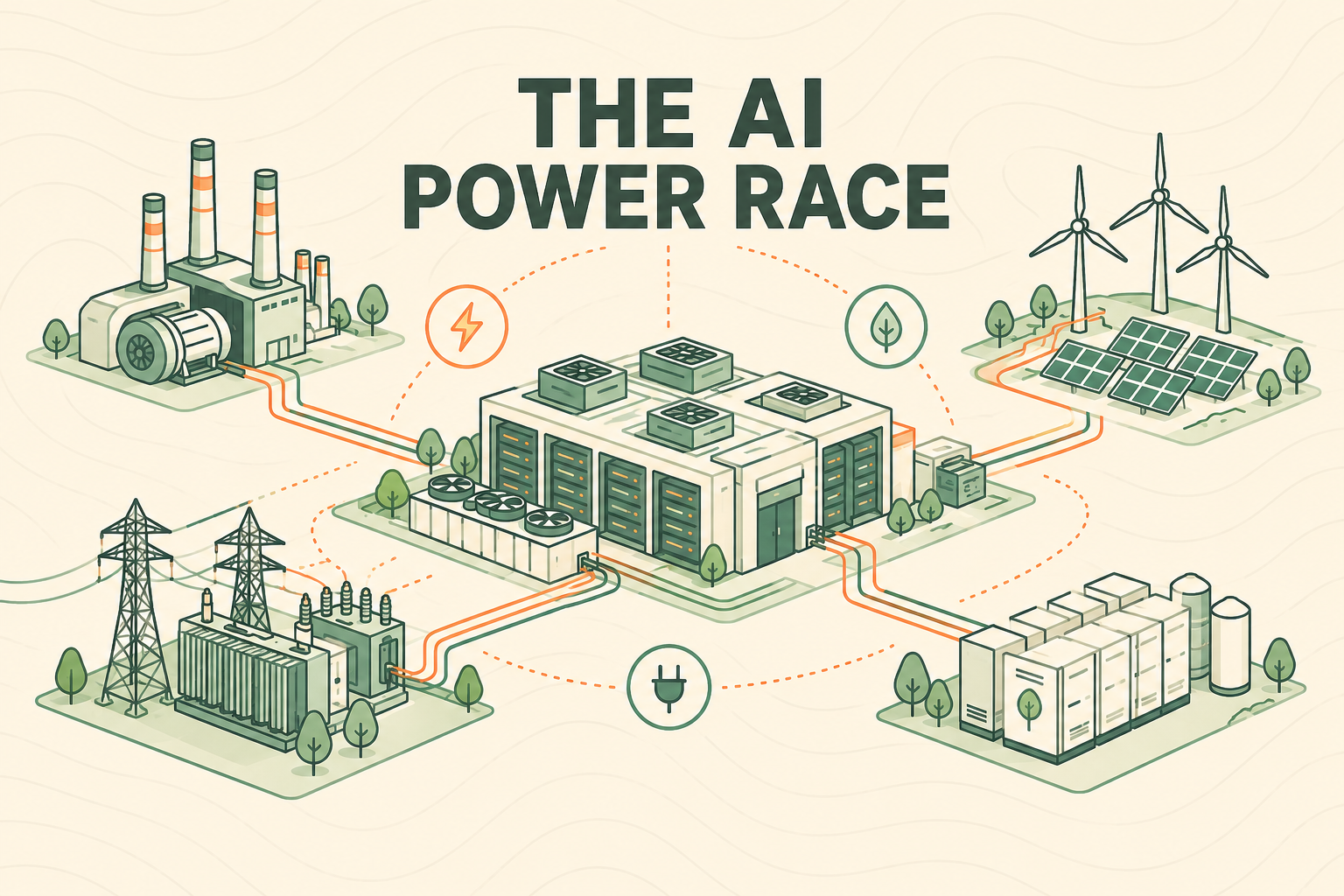
The economics of AI are becoming inseparable from the economics of energy. As technology companies commit billions of dollars to increasingly powerful data centers, the infrastructure required to operate them is emerging as an investment theme in its own right. For Vertiv, GE Vernova and Bloom Energy, the opportunity is not to develop better artificial intelligence, but to supply the physical systems without which much of it cannot function.
When the Digital Economy Meets the Physical Grid
The scale of the problem is becoming clearer. In its latest assessment, the International Energy Agency estimates that global data-center electricity consumption could almost double, from 485 terawatt-hours in 2025 to roughly 950 terawatt-hours by 2030. AI-focused facilities are expected to grow considerably faster, with their electricity consumption potentially tripling over the same period.
These projections are not guarantees. They depend on investment, technological progress and the commercial success of AI applications, all of which remain uncertain. Nevertheless, the direction of travel is unmistakable: a growing share of the digital economy requires increasingly substantial physical infrastructure.
The difficulty is that data centers can be built more quickly than many electricity networks can be expanded. New generating capacity, transmission lines, transformers and substations involve lengthy planning, manufacturing and regulatory processes. A developer may secure land and financing for a new AI facility only to discover that obtaining a sufficiently large grid connection is the more formidable obstacle.
The problem is also becoming more technically demanding. Modern AI processors concentrate extraordinary computing power into individual server racks, producing heat and creating electrical loads that differ considerably from those of conventional enterprise computing. The International Energy Agency estimates that the power density of AI servers increased elevenfold between 2020 and 2025, with further substantial increases expected by 2027.
The result is a new hierarchy of constraints. Access to computing chips remains essential, but electricity supply, power distribution and cooling increasingly determine how quickly those chips can be put to productive use. This creates commercial opportunities at several points in the infrastructure chain, from the equipment that manages electricity inside a data center to the turbines and fuel cells that generate it.
Vertiv: Keeping the Machines Running
NYSE: VRT | Data-Center Power and Thermal Infrastructure
Among the companies positioned to benefit from this transformation, Vertiv offers one of the clearest examples of how AI spending is reaching the industrial economy. The Ohio-based company supplies power management, cooling and related infrastructure used to operate data centers and other critical facilities. Its products are rarely visible to end users, but they perform functions without which the most sophisticated computing systems would be of little use.
The shift toward AI has made these capabilities more important. Powerful processors generate enormous quantities of heat, requiring cooling systems that can operate efficiently at much higher equipment densities. At the same time, interruptions in electricity supply can impose substantial financial costs on data-center operators, increasing the importance of resilient power infrastructure.
Vertiv's recent financial results suggest that these requirements are translating into commercial demand. On October 28, the company reported third-quarter 2026 revenue of $4.31 billion, an increase of 61% from the previous year. Organic revenue growth reached 55%, indicating that most of the expansion came from the underlying business rather than acquisitions.
Profitability improved alongside sales. Adjusted operating margin reached 25.2%, an increase of 2.9 percentage points, while adjusted free cash flow rose to $652 million. For the full year, management now expects approximately $14.65 billion in revenue at the midpoint of its guidance, with adjusted free cash flow between $2.6 billion and $2.8 billion.
These figures distinguish Vertiv from companies whose AI exposure is principally theoretical. Demand for its equipment is already reflected in orders, revenue and cash generation, while its investment in manufacturing capacity suggests management expects the expansion to continue.
Yet the strength of the business does not eliminate the investment risks. Rapid growth can create operational pressures, particularly when manufacturers must expand production, secure components and deliver increasingly sophisticated equipment on demanding schedules. Customers may also delay projects if financing becomes more expensive or the economics of AI infrastructure deteriorate.
Vertiv's longer-term prospects will depend partly on whether it can maintain pricing power as competitors expand their offerings. Cooling technology is evolving quickly, and the industry's transition toward more advanced liquid-cooling systems requires continuous investment. A company that benefits from a period of exceptional demand must still demonstrate that its competitive advantages will survive once supply becomes less constrained.
The central attraction of Vertiv is therefore also its principal challenge. It is closely exposed to the infrastructure expansion supporting AI, which makes it a direct beneficiary of investment growth but also leaves it sensitive to changes in data-center spending.
GE Vernova: The Industrial Scale of the AI Boom
NYSE: GEV | Electricity Generation and Grid Equipment
If Vertiv addresses the challenges inside the data center, GE Vernova operates further upstream. The company manufactures electricity-generation equipment and provides technologies used to transmit, distribute and manage power. Its portfolio includes gas turbines, grid infrastructure and renewable-energy equipment, giving it exposure to a broad expansion in electricity demand.
The AI investment cycle has strengthened the case for new generating capacity, particularly where existing networks cannot accommodate large additional loads. Natural gas has attracted attention because gas-fired plants can provide substantial, dispatchable electricity, although their construction still requires considerable time and investment. Grid equipment is equally important because additional generation has limited value unless electricity can reach the facilities that need it.
GE Vernova's latest results demonstrate the scale of this industrial expansion. In the third quarter of 2026, the company reported revenue of $12.6 billion, an increase of 27% from a year earlier, while orders reached approximately $29.3 billion. Its total backlog rose to $197 billion, reflecting substantial demand for power equipment and services.
The company's gas-power business has become particularly noteworthy. Its combined equipment backlog and slot reservation agreements reached 122 gigawatts, and management expects that figure to reach at least 130 gigawatts by the end of 2026. Such reservations indicate strong demand for future manufacturing capacity, although they should not all be treated as equivalent to firm, fully recognized revenue.
The electrification division offers another route into the AI infrastructure market. Revenue in that business increased 51% in the quarter, while its equipment backlog reached $42.2 billion. GE Vernova has also announced an agreement to acquire Trench Group, a manufacturer of high-voltage grid equipment, for approximately $9 billion, subject to regulatory approvals and other closing conditions.
These developments illustrate why the AI power story extends beyond the construction of new generating plants. Electricity networks require transformers, substations and specialized equipment, much of which must be manufactured by companies with established industrial capabilities. The resulting demand may persist even if individual data-center projects are delayed, because utilities are also investing to modernize aging networks and accommodate broader electrification.
GE Vernova's financial performance has improved markedly. Third-quarter net income reached $1.3 billion, while management raised its full-year revenue guidance to between $46.5 billion and $47.5 billion. The company also increased its share repurchase authorization, reflecting confidence in its financial position.
Investors should nevertheless distinguish the AI opportunity from the company's broader operations. GE Vernova serves utilities, industrial customers and electricity markets around the world, and its results are influenced by factors extending well beyond data centers. Its wind business, for example, operates under different commercial and regulatory conditions from its gas-power and electrification divisions.
There is also a question of timing. A large equipment backlog provides visibility into potential future revenue, but manufacturing capacity, project execution and customer financing determine when that revenue is realized. Industrial expansion can be profitable, yet it is rarely frictionless.
For investors, GE Vernova represents a diversified way to examine the consequences of rising electricity demand. AI may be an important contributor to that demand, but the company's fortunes ultimately depend on the wider investment cycle in power generation and electrical infrastructure.
Bloom Energy: Bringing Electricity to the Customer
NYSE: BE | Onsite Fuel-Cell Power Generation
Bloom Energy approaches the electricity problem from a different direction. Rather than relying exclusively on utilities to expand their networks, the California-based company manufactures fuel-cell systems capable of generating electricity directly at or near a customer's facilities. Its technology offers an alternative for businesses unwilling or unable to wait for conventional grid connections.
Fuel cells generate electricity through an electrochemical process rather than combustion. Bloom's systems can operate on natural gas and, subject to configuration and fuel availability, hydrogen, allowing them to provide continuous power without the same combustion process used in conventional gas turbines. This does not make their electricity emissions-free, particularly when natural gas is the fuel, but it creates a different combination of efficiency, emissions and deployment characteristics.
For AI developers, the most attractive feature may be speed. A data center that cannot secure electricity for several years faces a substantial opportunity cost, particularly when its computing equipment is expensive and technology evolves rapidly. Onsite generation can potentially bring that facility into operation sooner, even if the electricity costs more than conventional grid power.
Bloom's relationship with Oracle provides an illustration of this proposition. In April 2026, the companies expanded their partnership under a framework supporting up to 2.8 gigawatts of fuel-cell capacity, including an initial 1.2 gigawatts of contracted deployments. Oracle subsequently announced that its Project Jupiter AI campus in New Mexico would use Bloom fuel cells as its planned primary power source, replacing an earlier design based on gas turbines and diesel generators.
The distinction between contracted capacity and the full potential agreement matters. A framework covering several gigawatts represents a substantial commercial opportunity, but the ultimate revenue depends on installations, contractual conditions and the pace at which customers develop their facilities.
Bloom has also expanded its relationship with Brookfield, which increased its financing framework for AI-related power projects from $5 billion to $25 billion in June. The arrangement could help address one of the principal obstacles to infrastructure development: securing sufficient capital to finance large installations. It should not, however, be interpreted as $25 billion in guaranteed revenue for Bloom.
The financial results are increasingly substantial. In October, Bloom reported third-quarter 2026 revenue of $1.24 billion, up 138% from the previous year, while GAAP operating income reached $225.4 million. Gross margin improved to 33.8%, and management raised its full-year revenue guidance to between $4.4 billion and $4.6 billion.
Such growth suggests that onsite generation is moving beyond a niche application. Nevertheless, rapid expansion introduces its own difficulties, including manufacturing requirements, supply-chain constraints, installation schedules and the need to provide reliable service over the operating lives of deployed systems.
The environmental economics also warrant scrutiny. Natural-gas-powered fuel cells can offer advantages in local air pollution and efficiency, but they remain dependent on fossil-fuel infrastructure and are exposed to fuel prices. Their attractiveness relative to grid electricity, renewable generation and battery storage will vary according to location, regulation and customer requirements.
Bloom's opportunity is therefore substantial but conditional. It is competing not simply to supply electricity, but to provide electricity quickly enough that customers regard the cost and complexity of onsite generation as preferable to waiting for the grid.
Three Companies, Three Different Economic Models
Vertiv, GE Vernova and Bloom Energy are frequently grouped within the broader AI infrastructure trade, but their commercial positions differ considerably. Understanding those differences is essential because rising electricity demand does not benefit every supplier in the same way or on the same timetable.
Vertiv is closely tied to the equipment installed within computing facilities. Its revenue is influenced by the construction of new data centers, the modernization of existing facilities and the adoption of more demanding cooling and power-management technologies. The company benefits when operators expand computing capacity, but it is also exposed to changes in capital expenditure.
GE Vernova operates across the wider electricity system. Its generating equipment, grid technologies and industrial services support utilities and other customers whose investment decisions are shaped by long-term demand forecasts, regulatory requirements and the condition of existing infrastructure. AI-related electricity demand may accelerate those investments, but it represents only one component of the company's broader market.
Bloom Energy occupies a more specialized position. Its fuel-cell systems offer customers a way to secure power at or near the point of consumption, potentially avoiding lengthy waits for conventional grid connections. The commercial opportunity depends on the relative costs of onsite generation, the urgency of customer requirements and the company's ability to manufacture and deploy systems at scale.
These distinctions also influence revenue visibility and investment risk. Vertiv's business benefits from equipment demand and service opportunities, GE Vernova has extensive industrial backlogs, and Bloom's performance depends on manufacturing and deploying power systems under commercial agreements.
None of these models is immune to changes in AI investment. A reduction in data-center construction could affect Vertiv relatively quickly, while GE Vernova's diversified customer base and longer project cycles may moderate its direct exposure. Bloom's outlook could prove particularly sensitive to the economics of onsite power and the ability of customers to proceed with large installations.
Valuation adds another layer of complexity. Strong revenue growth can justify considerable investor interest, but it does not establish that a share price offers attractive prospective returns. Investors must consider how much future growth is already reflected in market valuations and whether profitability can continue improving as capacity expands.
The Cost of Building an AI Economy
There is a broader economic question behind the demand for electricity infrastructure. AI developers are investing heavily in computing capacity because they expect that capacity to generate future revenue, improve productivity and support new services. The infrastructure companies supplying those developers are benefiting from expenditure that precedes, in many cases, the full realization of those expected returns.
This creates a familiar pattern in technological investment cycles. Suppliers of essential equipment can enjoy strong demand while customers compete to build capacity, even before the final economics of the new technology are fully established. Such periods can be highly profitable, but they can also encourage overinvestment if expectations move ahead of commercial reality.
The AI industry is not exempt from these pressures. Data-center construction requires substantial capital, while electricity infrastructure adds another layer of cost and complexity. If the returns on AI computing fall short of expectations, some projects may be delayed, redesigned or abandoned.
Electricity demand also raises questions extending beyond corporate profitability. Communities and regulators must consider whether large new loads increase costs for other consumers, strain water supplies or require additional fossil-fuel generation. The political acceptability of AI infrastructure could become as important as its technical feasibility.
The energy mix will matter as well. Renewable electricity, natural gas, nuclear power, storage and onsite generation each offer different combinations of cost, reliability, emissions and construction time. The eventual outcome is unlikely to be dominated by a single technology, particularly across markets with different resources and regulatory systems.
For the three companies examined here, that diversity creates both opportunity and uncertainty. GE Vernova participates across several forms of power infrastructure, Vertiv supplies equipment needed regardless of how electricity is generated, and Bloom offers a particular solution to the problem of obtaining dependable power quickly.
The Next Phase of the AI Investment Cycle
The growing importance of electricity may change how investors assess the artificial intelligence industry. Until recently, attention was concentrated on processors, foundation models and the companies developing consumer and enterprise AI applications. Increasingly, the ability to construct and operate the necessary physical infrastructure is becoming a determining factor in commercial expansion.
That shift does not mean that power suppliers will automatically outperform technology companies. Industrial businesses face competition, cost inflation, operational constraints and changing demand, while equity valuations can anticipate years of favorable conditions. A compelling economic trend and an attractive investment are not necessarily the same thing.
Nevertheless, the financial evidence from Vertiv, GE Vernova and Bloom Energy indicates that the infrastructure opportunity is no longer confined to forecasts. All three reported substantial revenue growth in their latest quarters, accompanied by improvements in important profitability measures. Their businesses provide different ways to participate in the expansion of electricity-intensive computing, each with its own economics and execution requirements.
The central issue for investors is whether these companies can convert an exceptional period of demand into durable earnings and cash generation. That will require maintaining margins, expanding capacity responsibly and adapting to a market in which technological requirements continue to evolve.
Artificial intelligence may ultimately transform industries through software, automation and new forms of intelligence. But its immediate expansion is being negotiated through transformers, cooling systems, turbines, fuel cells and electricity networks.
The next chapter of the AI economy may therefore be written as much in industrial order books as in software laboratories. The companies capable of supplying reliable power, at scale and on commercially acceptable terms, will help determine not only who profits from the infrastructure boom, but how quickly the technology itself can advance.
Editorial Disclosure
Neural Capital has not received payment, sponsorship or compensation from Vertiv, GE Vernova, Bloom Energy, or any other company mentioned in this article. This publication is intended for independent editorial and informational purposes only and does not constitute investment advice or a recommendation to buy or sell securities. Readers should conduct their own due diligence, review official financial disclosures, and consider their individual investment objectives and financial circumstances before making investment decisions.
Want to invest in VRT?
Visit our How to Invest page to get started with platforms like Fidelity or Robinhood.
Disclosure: This article is editorial and not sponsored by any companies mentioned. The views expressed in this article are those of the author and do not necessarily reflect the official policy or position of NeuralCapital.ai.